UNIST site map
- Admissions
-
Academics
- Colleges and Schools
-
Academic Affairs
- Academic Calendar
- Academic Curriculum
- Requirements for Graduation
- Browse Open Courses
- Undergraduate Administration
-
Graduate Academic Affairs
- Tuition Fee Payment
- Academic Leave of Absence/ Academic Return
- Voluntary Withdrawal/ Expulsion
- Change of Major
- Change of Degree Program/ Dropping of Degree Program
- Class Period/ Attendance Period/ Academic Year・Semester
- Course Registration
- Course Drop
- Attendance/ Grade/ Exam
- Credit Transfer/ Credit Carryover
- Academic Forms
- Education Support
-
Research/Industry
- Research Aims
- Research Findings
- Researcher Search
-
Research Organizations
- UNIST Multi-Interdisciplinary Institute
- IBS Research Groups
-
UNIST Labs
- Department of Mechanical Engineering
- School of Energy and Chemical Engineering
- Department of Civil
- Department of Materials Science and Engineering
- Department of Nuclear Engineering
- Department of Industrial Engineering
- Department of Design
- Department of Biomedical Engineering
- Department of Biological Sciences
- Department of Electrical Engineering
- Department of Computer Science and Engineering
- Department of Mathematical Sciences
- Department of Chemistry
- Department of Physics
- School of Business Administration
- Graduate School of Carbon Neutrality
- Graduate School of Artificial Intelligence
- Research Support
- University-Industry Relations
- Campus Life
- News Center
- About UNIST
-
etc
- UNIST Bulletin
- Work-Life Balance Support System
- UNIST Gender Equality Plan
- Faculty Invitation for Tenure Track
- Faculty Invitation for Non-Tenure Track
- Board Meeting Minutes
- University Council Meeting Minutes
- Administrative Service Charter
- Privacy Policy
- Copyright Policy
- Rejection of Unauthorized Email Collection
- Operation and Management Policy for Video Information Processing Devices
- Information Disclosure


Connection Points of Knowledge, Everything About UNIST
Try searching.
Recommended search terms


- portal
- U Academics Innovation Center
- Leadership Center
- Dormitory
- Academic Information Center
- International Students Support
- Browse Open Courses
- Course Registration
- Graduation Requirements for Graduation
- Academic Leave of Absence/ Academic Return
- Military Service
- Certificate Issuance
- Academic Calendar
- Scholarships
- Campus Map
- Campus Life Guidebook
- Health Care Center
- Human Rights Center
- portal
- Job Opening
- Announcement for Bid
- UNIST AI Services
- UNIST Daycare Center
- Sports Center
- UI Downloads
- Announcement
- Recruitment of Professors (Non-tenure)
- Faculty Invitation for Tenure Track
- UNIST Academic Information Center
- Office of Research Facilities and Training
- Office of Research Affairs
- Rule Management System
- Academic Calendar


This is a collection of menus necessary for UNIST students .
students
- portal
- U Academics Innovation Center
- Leadership Center
- Dormitory
- Academic Information Center
- International Students Support
- Browse Open Courses
- Course Registration
- Graduation Requirements for Graduation
- Academic Leave of Absence/ Academic Return
- Military Service
- Certificate Issuance
- Academic Calendar
- Scholarships
- Campus Map
- Campus Life Guidebook
- Health Care Center
- Human Rights Center


This is a collection of menus necessary for prospective UNIST Students .
prospective Students


This is a collection of menus necessary for UNIST Faculty & Staff .
Faculty & Staff
- portal
- Job Opening
- Announcement for Bid
- UNIST AI Services
- UNIST Daycare Center
- Sports Center
- UI Downloads
- Announcement
- Recruitment of Professors (Non-tenure)
- Faculty Invitation for Tenure Track
- UNIST Academic Information Center
- Office of Research Facilities and Training
- Office of Research Affairs
- Rule Management System
- Academic Calendar


NEWS CENTER
Discover not only Research Findings and event news, but also the diverse facets of UNIST presented by reporters and writers.
News Center

UNIST News
Innovative All-Organic Photoelectrode Developed to Enhance Eco-Friendly Solar Hydrogen Production
The findings of this research were published in ACS Energy Letters on March 14, 2025.
- Research
- JooHyeon Heo
- 2025.04.30
- 1075
Abstract Organic photoelectrochemical (OPEC) cells are efficient at generating photocurrents but face significant challenges in long-term stability due to the incompatibility of metal oxide charge transport layers with organic photoactive materials and their pH sensitivity. To overcome these issues, we developed an all-organic photoanode incorporating n-type self-assembled monolayers (SAMs) with imide core modifications, which optimize the work function of the ITO substrate, improving charge transfer and the onset potential (Vonset). The addition of a hole-transporting p-type conjugated polyelectrolyte (TPAFS-7TMA) further enhances hole transport and water wettability. This photoanode, designed for ascorbic acid oxidation, achieved a Vonset of 0.25 VRHE and a photocurrent density (Jph) of 7.92 mA cm–2 at oxidation potential and retained 90% of its initial Jph over 2 h under 1 sun irradiation. This all-organic design effectively addresses the limitations of conventional OPEC cells, providing a stable and efficient alternative for durable OPEC systems. We developed a stable and efficient all-organic photoanode for OPEC cells, utilizing imide-modified n-type SAMs and a p-type conjugated polyelectrolyte to enhance charge transfer, water wettability, and durability, achieving significant performance improvements.
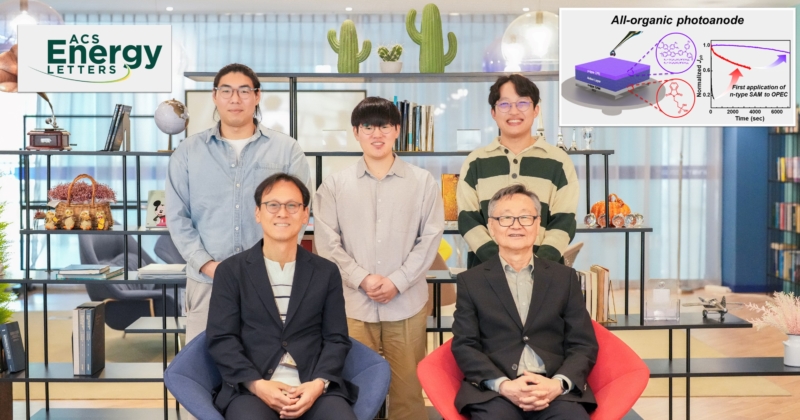
A research team, affiliated with UNIST has unveiled a new technology, capable of making solar-powered hydrogen production more stable and cost-effective. This breakthrough involves constructing the entire photoelectrode, a key component in hydrogen generation, entirely from organic materials—overcoming longstanding issues of corrosion and delamination associated with conventional organic photoelectrodes.
Led Professor Jin Young Kim from the Graduate School of Carbon Neutrality at UNIST, in collaboration with Professor Jae Sung Lee from the School of Energy and Chemical Engineering, and Professor Han Young Woo from the Department of Chemistry at Korea University, the team announced that they have developed an all-organic photoanode that eliminates the need for metal oxides.
Solar hydrogen production operates on the principle that when sunlight irradiates a photoelectrode submerged in water, electrochemical reactions occur on its surface, splitting water molecules into hydrogen and oxygen. To maximize efficiency, these reactions typically occur in acidic or alkaline solutions. However, conventional organic photoelectrodes often rely on metal oxide charge transport layers, which are prone to corrosion or delamination in such environments, resulting in compromised stability.
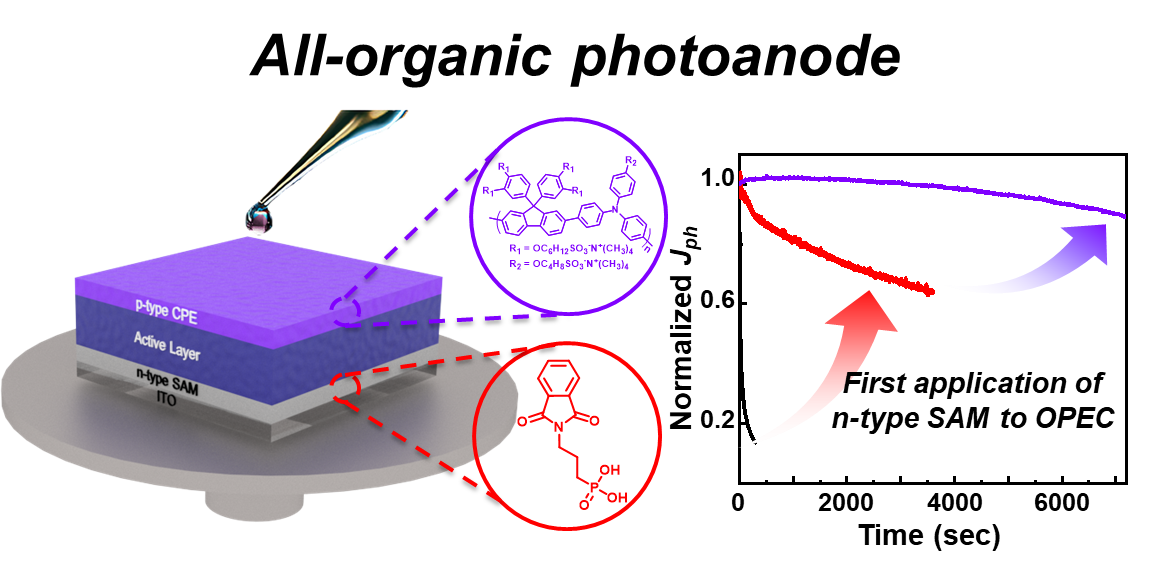 Figure 1. Schematic image, illustrating the structure and performance of the highly stable all-in-one photoelectrode.
To address these challenges, the researchers developed a fully organic photoelectrode utilizing n-type self-assembled monolayers (SAMs) and p-type conjugated polymer electrolytes. The n-type SAM replaces metal oxides, enhancing adhesion between the substrate and the organic active layer while significantly improving electron transfer efficiency. The p-type polymer layer on the surface selectively transports holes and increases surface hydrophilicity, thereby improving contact with the aqueous solution.
The newly developed all-organic photoelectrode demonstrated a high photocurrent density of 7.92 mA/cm² in an acidic environment containing ascorbic acid. This performance metric directly correlates with hydrogen production rate. Remarkably, the device maintained over 90% of its initial performance after two hours of continuous illumination without the need for protective coatings or metal encapsulation, confirming its exceptional stability.
Professor Kim stated, "This research fundamentally resolves the pH sensitivity and delamination issues that have historically limited organic photoelectrodes," adding, "Applying n-type self-assembled monolayers to the photoanode for the first time and constructing a fully organic photoelectrode demonstrates the practical viability of entirely organic systems." He further noted, "This technology not only advances eco-friendly hydrogen production but also opens avenues for developing diverse organic-based photoelectrochemical devices."
The study was conducted by Dr. Jiwoo Yeop and Dr. Jin Uk Lee from UNIST, along with Jae Hoon Son (Combined M.S. and Ph.D., Department of Chemistry) from Korea University, serving as the first authors. The research was published in the March 14 issue of ACS Energy Letters and was supported by the National Research Foundation of Korea (NRF) under the Ministry of Science and ICT.
Journal Reference
Jiwoo Yeop, Jae Hoon Son, Jin Uk Lee, et al., "Realization of All-Organic Photoanodes for Photoelectrochemical Cells," ACS Energy Lett., (2025).
Related Links
Related Photo


-
Game-Changing Interface Coating Enables Scalable, High-Efficiency Perovskite/Silicon Solar Cells
-
Roll-to-Roll Manufacturing of Ruthenium-Loaded Carbon Fiber Electrodes for Efficient Hydrogen Production
-
New Research Reveals High-Performance Organic Solar Cells Surpassing AI Predictions
-
New Study Unveils Water-Responsive Luminescent Material